Few institutions provoke as much instinctive resistance as the taxman. Across Nigeria, the mere mention of taxes can trigger a familiar chorus: government waste, poor services, harassment by revenue agents, and the feeling that citizens are being asked to give more while receiving little in return.
In a country where economic pressures are real and trust in institutions has often been fragile, this reaction is not entirely surprising. Yet the current debate around Nigeria’s new tax reforms reveals something deeper: a longstanding national discomfort with taxation itself.
But taxes are not an invention of modern bureaucracies. They are as old as civilization. And the famous phrase “Give unto Caesar what is Caesar’s” captures one of the earliest and most enduring reflections on the relationship between citizens and the state.
Today, as Nigeria undertakes one of the most comprehensive fiscal reforms in decades through the new tax framework—including the Nigeria Tax Act and related legislation—revisiting that ancient principle may be more relevant than ever.
Who Was Caesar — and Why the Phrase Matters
The phrase “Give unto Caesar what is Caesar’s” originates from a biblical account recorded in the Gospels. In Roman Judea, religious leaders attempted to trap Jesus Christ with a politically charged question: Should Jews pay taxes to the Roman emperor?
The Roman emperor at the time—often generically referred to as “Caesar”—was the ultimate authority of the empire. Taxes were levied to sustain governance, maintain roads and infrastructure, fund armies, and administer the state.
When asked whether paying taxes to Caesar was legitimate, Jesus requested a coin and asked whose image appeared on it. The answer, of course, was Caesar’s.
His reply was simple but profound:
“Render unto Caesar the things that are Caesar’s, and unto God the things that are God’s.”
The statement was not merely theological. It acknowledged a fundamental principle of governance: societies function because citizens contribute resources to sustain collective order.
Taxes were the price of civilization long before modern states existed.
Nigeria’s Longstanding Tax Problem
Nigeria’s challenge is not simply taxation—it is tax culture.
Despite being Africa’s largest economy, Nigeria has one of the lowest tax-to-GDP ratios in the world, historically hovering around 6–8 percent. By comparison, many emerging economies operate with tax ratios above 15 percent, while developed economies exceed 25 percent.
The implication is stark: Nigeria’s government often attempts to fund a complex modern state with revenues that are structurally inadequate.
For decades, oil revenues masked this weakness. Petroleum receipts allowed government to operate without building a broad tax base. The unintended consequence was a distorted fiscal culture in which many citizens came to see taxation as optional—or even illegitimate.
But as global energy markets fluctuate and economic diversification becomes imperative, the limitations of that model have become increasingly clear.
Why Nigerians Distrust the Taxman
Public resistance to taxation in Nigeria is not simply ideological. It has historical roots.
For many citizens, the “tax experience” has often meant aggressive enforcement by poorly coordinated revenue agents, multiple levies imposed by different tiers of government, and limited transparency about how public funds are spent.
In some cases, the taxman has appeared less like a civic institution and more like an adversary.
This experience created a perception problem: taxes are viewed not as contributions to shared development but as burdens imposed without visible benefits.
Rebuilding tax culture therefore requires more than enforcement. It requires reform.
The Logic Behind Nigeria’s New Tax Reforms
Nigeria’s current tax reform effort seeks to address precisely this challenge.
The new framework—anchored by the Nigeria Tax Act, the Nigeria Tax Administration Act, and related legislation—aims to modernize the country’s fiscal architecture.
The reforms pursue several core objectives:
Simplification. Nigeria’s tax system has historically been fragmented, with overlapping laws and complex compliance procedures. The new framework harmonizes and streamlines these provisions.
Fairness. The reforms introduce clearer thresholds and protections designed to shield low-income earners while ensuring that those with greater capacity contribute appropriately.
Efficiency. By modernizing tax administration and reducing duplication across agencies, the reforms aim to minimize arbitrary enforcement and improve compliance.
Transparency. Digitalization and standardized procedures are intended to make the tax system more predictable and less susceptible to abuse.
In essence, the reforms seek to transform taxation from a coercive encounter into a structured civic obligation.
Why Taxes Are Not the Enemy
The paradox of taxation is that societies often resent it even while depending on the services it finances.
Roads, hospitals, schools, security, and infrastructure do not emerge spontaneously. They require sustained public investment.
Taxes are the mechanism through which citizens collectively finance these goods.
When citizens refuse to pay taxes, governments become dependent on volatile revenue sources—such as natural resources or debt. The result is fiscal instability and limited capacity to invest in long-term development.
A functioning tax system, by contrast, strengthens the social contract between citizens and the state.
The Misinformation Problem
The current debate around Nigeria’s tax reforms has also been shaped by widespread misinformation.
Some critics have portrayed the reforms as punitive or excessively burdensome. Others have suggested that the reforms introduce entirely new taxes or target vulnerable groups.
In reality, many of the reforms aim to simplify existing taxes rather than multiply them, while expanding exemptions and protections for low-income earners and small businesses.
Misconceptions often arise when complex fiscal policies are reduced to slogans or selectively interpreted for political advantage.
Public education therefore becomes essential—precisely the kind of civic awareness effort currently being undertaken by policy communicators and institutions across the country.
Rebuilding the Social Contract
Ultimately, the debate about taxes is not merely about revenue. It is about trust.
Citizens are more willing to pay taxes when they believe their contributions translate into visible public goods. Governments are more effective when they rely on stable domestic revenue rather than volatile external sources.
The challenge for Nigeria is therefore twofold: to build a fairer tax system and to demonstrate that tax revenues are being used responsibly.
Reform must address both sides of the equation.
Giving Unto Caesar — in a Modern Republic
Centuries ago, when the rabbis attempted to trap Jesus with a politically loaded question about paying taxes to the Roman emperor, he responded with a simple but profound answer: “Give unto Caesar , what belongs to Caesar.”
With that response, he avoided the trap while affirming a fundamental civic principle—that societies function because citizens contribute to sustaining the state.
Today, Nigeria confronts a modern version of that same question: Should Nigerians pay taxes to the state?
The answer is yes—and for very practical reasons.
No nation can build roads, fund schools, provide security, maintain hospitals, or invest in infrastructure without revenue. Taxes are the foundation upon which modern states function. They are not merely financial obligations; they are contributions to a collective national enterprise.
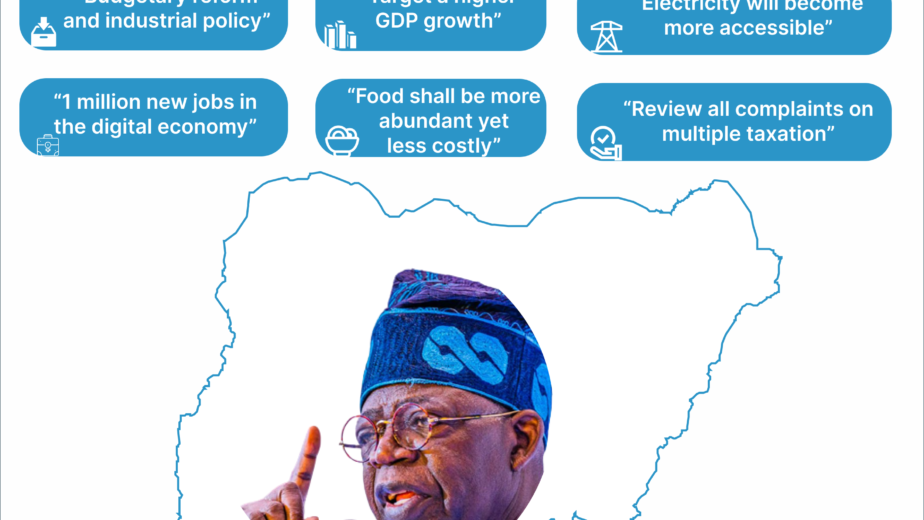
For too long, Nigeria relied heavily on oil revenues to sustain government. That dependence weakened the culture of taxation and distanced citizens from the fiscal life of the nation. The ongoing tax reforms, alongside the broader economic recalibration under the Renewed Hope Agenda, represent an effort to restore that balance—building a system where taxation is clearer, fairer, and more structured.
In the end, the question is no longer whether Nigerians should give unto Caesar. A functioning republic requires that citizens contribute to the common purse. The real task now is ensuring that what Caesar receives—what the state collects—is used transparently, responsibly, and for the common good.
This is what President Tinubu has since set out today, and which The Renewed Hope Ambassadors have been inaugurated to explain.